

Cocaine is a commonly used illegal recreational drug that may have significant cardiovascular implications. In particular, subacute or even chronic cardiomyopathy resulting from cocaine use has been increasingly recognized.
If treat with Homeopathy, all cases of cocaine-related cardiomyopathy have proved to be reversible. Others treated with allopathy have resulted in permanent cardiac dysfunction or death.
Many deaths in the drug abuse population are ascribed to drug toxicity without further attempts at defining the exact etiology.
Complication
Complications of cocaine use also include embolic disease (cerebral and in other organs). Ischemic stroke is seen in the highest frequency in the first few hours after cocaine use, likely due to a thrombogenic effect associated with platelet activation.
However, stroke onset may be delayed as long as 1 week, possibly due to the formation of longer-acting secondary metabolites. Cerebral atrophy is also a known feature of chronic cocaine use.
Cardiac Effects of Cocaine
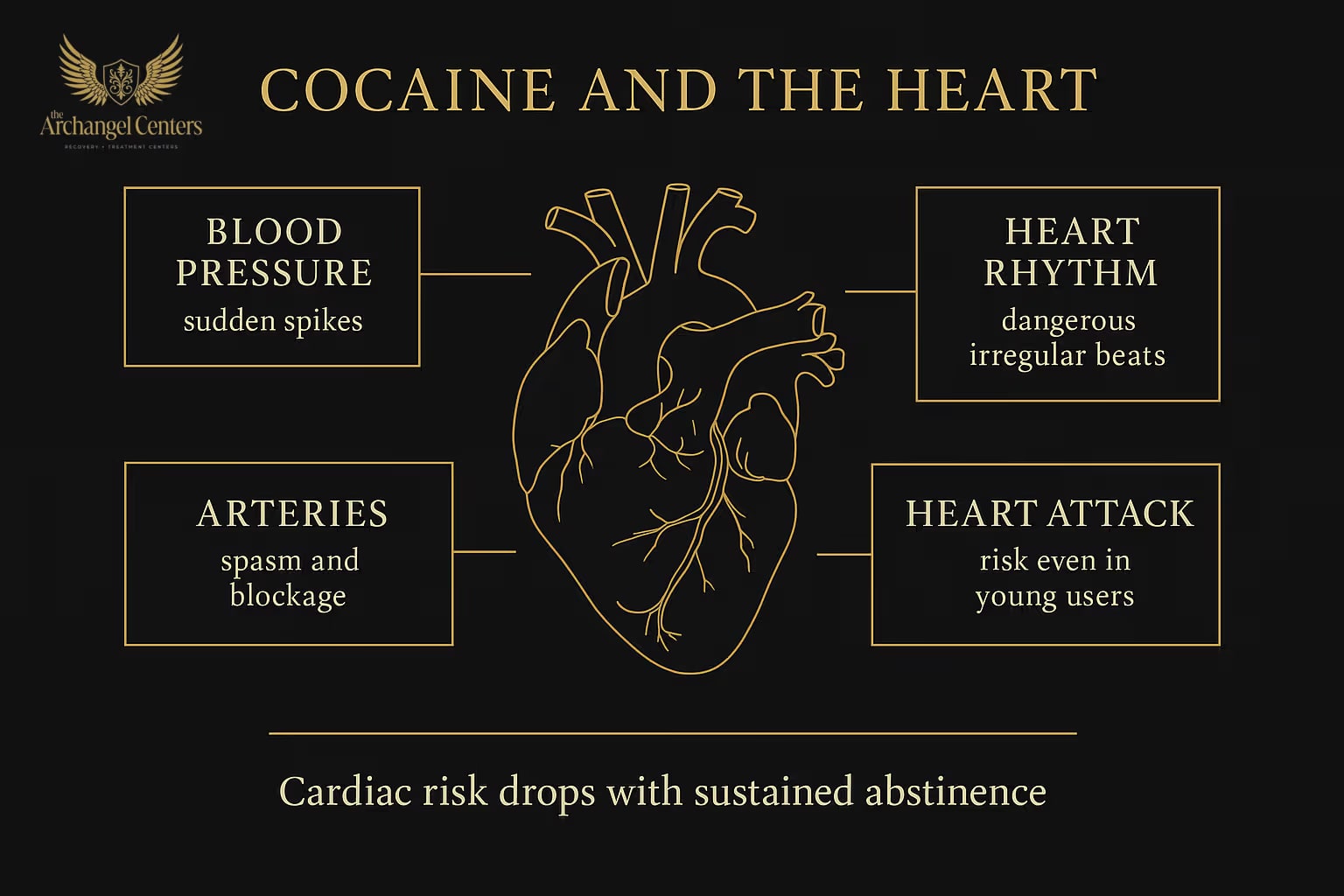 The onset of action of cocaine occurs over seconds to minutes; this drug has a half-life of about 90 minutes.
Cardiac effects from cocaine use include chronic cardiomyopathy, which may have subclinical, hypertrophic, and dilated phases; catecholamine-induced cardiomyopathy; myocardial infarction, and myocarditis, among others.
Arterial hypertension, intraventricular conduction anomalies, and chronotropic and inotropic uninhibited triggering results in cardiotoxicity.
Effects on cardiac muscles
The effect of cocaine on cardiac muscle and coronary vessels is the vasoconstrictive action of the drug is the predominant effect. Coronary vasoconstriction resulting in myocardial ischemia or infarction and systemic vasoconstriction resulting in hypertension or organ ischemia (particularly cerebral) are observed.
Cocaine is known to block the reuptake of norepinephrine and dopamine at preganglionic sympathetic nerve endings, and this action by the drug is presumed to cause the increase in heart rate and blood pressure and the acute vasospastic syndromes observed in individuals who use cocaine.
Moreover, pathologic similarities between cocaine-related cardiomyopathy and cardiomyopathy associated with pheochromocytomas suggest that chronic adrenergic stimulation may play a role in the development of cocaine-related cardiomyopathy.
Cocaine effects on molecular and cellular levels
 Cocaine inhibits the transient inward flux of sodium across the cell membrane during depolarization and causes local anesthesia. Neurotransmitters released from cardiac sympathetic nerves bind to alpha- and beta-adrenergic receptors, eliciting a cascade of intracellular responses.
Beta-adrenergic stimulation activates adenylate cyclase, which increases cyclic adenosine monophosphate (AMP) levels and causes increased calcium influx into myocardial cells.
The resultant increased intracellular levels of free calcium, including calcium released from cytosolic stores, results in increased force of contraction of the myocyte.
Alpha-adrenergic receptor stimulation produces a cascade of second messenger systems that subsequently regulate calcium channels and in turn elicit increases in cytosolic calcium. Elevated cytosolic calcium can provoke oscillatory depolarizations of the cardiac membrane and trigger sustained action potential generation and extra systoles.
Cellular effects that have been suggested including changes in calcium flux that are similar to those of other cardiac toxins, including digoxin. Increased intracellular concentrations of calcium have been suggested as a cause of depolarization of the cardiac membrane, a trigger of sustained action potentials, extra systoles, and tachycardia (sinus, supraventricular, or ventricular).
This effect may be present with acute cocaine use. Also, a high concentration of calcium may decrease myofilament responsiveness.
Lab trails
Oxidative stress and mitochondrial dysfunction have been implicated in cocaine-related cardiomyopathy. In male Wistar rats injected with cocaine to produce left ventricular dysfunction, Isabelle et al prevented cocaine-related cardiomyopathy with administration of nicotinamide adenine dinucleotide phosphate (NADPH) oxidase and xanthine oxidoreductase inhibitors, thereby preventing excess production of reactive oxygen species.
Decreased calcium concentrations may occur later in the course of cocaine use and result in depressed myocardial function. A local anesthetic action is also observed, similar to lidocaine, which can acutely depress myocardial contractility.
Several studies demonstrated that chronic cocaine use has a direct depressive effect on left ventricular function. This effect seems to be independent of myocardial blood flow and coronary artery diameter.
Long-term cocaine use has been associated with regional left ventricular diastolic dysfunction and minor systolic dysfunction when analyzed by magnetic resonance imaging (MRI).
However, later studies utilizing MRI showed that the systolic component has a more significant impact on the left ventricular dysfunction.
Cocaine users had significantly increased right and left ventricular end-systolic volumes, and there was a significant association between the probability of developing left ventricular systolic dysfunction and the number of years of cocaine use.
Acute and chronic effects of cocaine use
Acute users
Regarding the subacute and chronic cardiomyopathies, a clear association has been made between ischemic cardiomyopathy and cocaine use. Regional wall motion abnormalities can be observed, even in patients with no history of myocardial infarction. This syndrome is characterized by evidence of multiple infarcts with normal coronary arteries upon catheterization. This is presumed to be present because of vasospasm or thrombosis.
Cocaine use has been shown to increase platelet aggregation and coagulation, leading to thrombus formation, endothelial damage, and accelerated atherosclerosis. Moreover, autopsies of chronic cocaine users have revealed the presence of mast cells in plaques, a cause of atheroma formation and progression.
Chronic users
Chronic cocaine use has been estimated to increase left ventricular muscle mass by up to approximately 70% without associated increases in arterial blood pressure, heart rate, renin, aldosterone, or cortisol. This has been related to an increase in cardiomyocyte protein content by protein kinase C alpha ̶ dependent mechanisms, leading to cardiomyopathy and cardiac hypertrophy.
Cardiac failure due to multiple infarcts is distinct from true cocaine-related cardiomyopathy. Cocaine-related cardiomyopathy shows global myocardial dysfunction. Both entities may be associated with normal coronary arteries or minimal atherosclerotic disease.
The situation is further complicated by reports of left ventricular aneurysm formation with embolization in patients with cocaine-related cardiomyopathy. Whether these cases represent cocaine-related cardiomyopathy or ischemic cardiomyopathy due to cocaine is unclear. The presence of both entities in the same patient also is theoretically possible.
Contributing factors
Other agents, particularly adulterants in street cocaine, such as allopathic sedatives and supplements, have been suggested as contributing to cocaine-related cardiomyopathy. Avitaminosis (vitamin deficiencies) associated with the use of allopathic drugs have also been suggested as contributing factors.
 When cocaine use is accompanied by alcohol intake, dopamine reuptake is blocked, which extends the effects of cocaine on the heart.
Patient History
A cocaine-related etiology for cardiomyopathy should be suspected in any patient with a history of cocaine use, particularly binge use, and heart failure, without another established etiology for the heart failure, such as coronary artery disease.
While direct questioning of the patient may yield the necessary drug-use information, if the clinical suspicion is high, the diagnosis of cocaine use should be investigated further, perhaps with a urine screen for cocaine and its metabolites.
Symptoms
Patients who use cocaine may have various symptoms referable to the cardiac system. Symptoms can include chest pain with or without myocardial ischemia or aortic dissection, hypertension with or without hypertensive crisis, cerebral ischemia, and hemorrhage.
Symptoms of headache and stroke may occur. Patients also may present with acute myocardial decompensation with or without pulmonary edema and shock. In this case, shortness of breath and hypo perfusion dominate the clinical picture. Testicular and renal infarction, seizures, and migraine may also occur.
Myocardial ischemia or infarct
Symptoms of chest pain are the most common manifestation of cocaine abuse, but chest pain may be of muscular origin, or it may represent ischemia or infarct. Associated symptoms of myocardial ischemia/infarct usually are present, including diaphoresis, nausea/vomiting, dyspnea, and a sense of impending catastrophe.
In patients presenting with chest pain, aortic dissection also should be considered.
Congestive heart failure
The symptoms of cocaine-related cardiomyopathy are the same as symptoms for other forms of congestive heart failure. The onset may be very sudden and of short duration.
A history of myocardial infarction (due to cocaine-induced vasospastic ischemia) may be present but often is absent.
Symptoms of chronic congestive heart failure usually are absent, but a history of prior congestive heart failure related to cocaine use may be present.
Physical Examination
Although older and younger patients are common, patients in case reports of cocaine-related cardiomyopathy usually are aged 30-40 years. This is younger than would be expected for a diagnosis of ischemic cardiomyopathy, but viral, toxic, or idiopathic etiologies (including postpartum) are well within this age range. Older patients should be considered if other etiologies are not apparent.
Acute adrenergic findings
 Cocaine intoxication usually presents with symptoms of adrenergic excess. Hypertension, occasionally in the range of hypertensive crisis, may be present. Cerebral vascular accidents of either thrombotic or hemorrhagic origin are not uncommon. Acute delirium and mania may be present, particularly if other drugs were used concurrently.
Tachycardia and arrhythmias also occur, particularly atrial fibrillation and premature ventricular contractions. Ventricular tachycardia and fibrillation are observed as well. Acute chest pain syndromes are common and may be due to chest wall pain syndromes or acute myocardial ischemia or infarct.
Finally, an increased incidence of aortic dissection and rupture occurs and must be included in the differential diagnosis. The clinician should search for the appropriate physical findings in these cases.
Findings of acute congestive heart failure
With acute binge use of cocaine, the patient may present with acute congestive heart failure and pulmonary edema. Hypotension, rather than hypertension, may predominate, making the diagnosis and treatment more difficult.
Cocaine-related cardiomyopathy presents more acutely than other types of congestive heart failure, and fewer findings of chronic congestive heart failure are present. Otherwise, the physical findings are similar. Diaphoresis, pallor, and acute dyspnea are present. Cardiogenic shock or evidence of cardiac ischemia also may be present.
Endocarditis
Bacterial endocarditis may accompany cocaine use if the drug was used intravenously. For unknown reasons, cocaine use has been observed as a greater independent risk factor for the development of endocarditis when compared with the use of other drugs.
Endocarditis associated with cocaine abuse has been observed to involve left-side cardiac valves more often, which is contrary to endocarditis associated with other drugs.
The clinician should search for evidence of valvular dysfunction, possibly acute, and embolic disease.
Findings related to drug abuse
If cocaine has been used intranasally, septal perforation and other signs of cocaine abuse may be present. Needle tracks and other skin changes may be seen, consistent with intravenous (IV) drug use.
Psychologic changes, with paranoid ideation, may be present and may make management more difficult.
Laboratory Studies
The laboratory investigation of cardiomyopathy of any etiology generally shows abnormalities of electrolytes and compromised renal function, with elevation of blood urea nitrogen (BUN) and creatinine.
Cocaine usually is evident on a urine toxicology screen, because these cases almost always present immediately after use of the drug. Because individuals who use cocaine are predisposed to the development of endocarditis, consider blood cultures if the setting is at all appropriate.
Imaging Studies
In cases of cardiomyopathy, the chest radiograph usually shows evidence of cardiomegaly and congestive heart failure. Evidence of septic emboli may be present if endocarditis is present. The radiograph may be normal in many cases.
Echocardiographic evaluation shows chamber dilation and global dysfunction or regional wall motion abnormalities if myocardial infarction is present. Echocardiographic studies have shown that individuals who abuse cocaine have an increased left ventricular mass index with a higher tendency toward increased posterior wall thickness.
MRI
Cardiac MRI can be used to evaluate and characterize myocardial tissue, and it can aid in differentiating between cocaine-induced MI, cocaine-induced myocarditis, and catecholamine-induced cardiomyopathy. Moreover, cardiac MRI is useful in the differential diagnosis between acute and chronic manifestations. In the setting of chronic cardiomyopathy, this imaging modality can assess biventricular function and the myocardium, aiding in determining the underlying etiology. The addition of late gadolinium enhancement helps in evaluating for fibrosis and necrosis.
Cardiac catheterization usually shows normal coronary arteries or only minimal disease, even in the presence of myocardial infarction. However, coronary angiography has demonstrated coronary artery aneurysms in 30% of cocaine users.
ECG
In acute chest pain syndromes, the electrocardiogram (ECG) may show evidence of acute ischemia or infarction. In cases of cardiomyopathy, the ECG is not specific but may show evidence of left ventricular hypertrophy and nonspecific ST-T wave changes. Arrhythmias also may be detected, and continuous monitoring may be advisable.
Treatments for Hypertension
Allopathic
Patients who present with hypertension may require no treatment except monitoring and the occasional use of benzodiazepines for sedation. In some cases, however, hypertension may be more severe, and patients may require treatment for hypertensive crisis. This should include IV vasodilators and, occasionally, diuretics.
Nitroglycerin is particularly useful if evidence of myocardial ischemia is present. If sympathetic blockers are needed (arrhythmia or ischemia), beta blockers should not be used as the sole agents, because this may lead to unopposed alpha activity and may worsen hypertension. An alpha blocker or ganglionic blocker may be used in conjunction with beta blockers.
Homeopathic
Whenever a doctor doesn’t know the reason for high blood pressure, how is it possible to treat hypertension without knowing the reason!
Here is the link for Homeopathic medicine for the treatment and complete cure of hypertension and its cause(s); doctor have to find perfect medicine for his/her patient to advise and treat/normalize hypertension forever.
Treatments for Myocardial Ischemia
Allopathic
 Chest pain is a common presentation in patients who use cocaine; this may be secondary to either myocardial ischemia or chest wall pain syndromes of other etiologies.
An electrocardiographic evaluation is required in all such cases to aid in differentiating these possibilities. Beta blockers are contraindicated in patients with a history of recent cocaine use and acute coronary syndrome because of an increased risk of coronary spasm.
If myocardial ischemia without ST segment elevation is present, the patient should receive nitroglycerin, preferably intravenously. Narcotics also may be helpful if relief cannot be obtained with nitroglycerin.
If an ST elevation is present, prompt cardiac catheterization should be performed. If that is not available, thrombolytic therapy should be considered.
Special care must be taken to exclude aortic dissection and intracranial bleeding, both of which are associated with cocaine use.
In the setting of cardiac arrhythmias, besides routine care, the addition of sodium bicarbonate to oppose the effects of cocaine on blocking sodium channels as well as the use of intravenous lipid emulsion therapy (cocaine is lipophilic) may be of benefit with extreme cocaine overdose.
Homeopathic treatment
Homeopathy is a veery vast field and has many good medicines for myocardial ischemia and infarction, click the link for detailed treatment, no need for any special care, catheterization, allopathic narcotics etc.
Treatments for Congestive Heart Failure
Allopathic
Allopathic treatment consists of the standard therapy for congestive heart failure (ie, diuretics and vasodilators), as tolerated. If shock is present, inotropic agents and vasopressors are indicated.
If evidence of ongoing ischemia is present, aggressive use of agents directed at relieving vasospasm (nitrates and calcium channel ̶ blocking drugs) are indicated. Dexmedetomidine, an alpha-2 adrenergic receptor antagonist, and midazolam are options in the setting of acute cocaine intoxication.
Endotracheal intubation may be necessary. If arrhythmias are present and are felt to be compromising the clinical situation, they should be treated aggressively.
The use of beta-blocking drugs as single agents is contraindicated owing to the potential for unopposed alpha-adrenergic activity.
A systematic review and meta-analysis that evaluated the association between cocaine, heart failure, a nd cardiomyopathy found that chronic cocaine use is associated with alterations in cardiac muscle anatomy and physiology, changes that Arenas et al indicate are more consistent functionally with diastolic heart failure and are potentially reversible with the use of beta blockers.
Homeopathic treatment
Homeopathic treatment for congestive heart failure is not only easy but is 100% successful, here is the link for the treatment/cure of congestive heart failure: https://drqaisarahmed.com/congestive-heart-failure/
P. S: This article is only for doctors and students having good knowledge about Homeopathy and allopathy.

For proper consultation and treatment, please visit our clinic.
 Dr. Sayyad Qaisar Ahmed (MD {Ukraine}, DHMS), Abdominal Surgeries, Oncological surgeries, Gastroenterologist, Specialist Homeopathic Medicines.
Senior research officer at Dnepropetrovsk state medical academy Ukraine.
Location: Al-Haytham clinic, Umer Farooq Chowk Risalpur Sadder (0923631023, 03119884588), K.P.K, Pakistan.
Find more about Dr Sayed Qaisar Ahmed at:
https://www.youtube.com/Dr Qaisar Ahmed